
Introducing Sentra Defender — AI-Powered Cheat Detection Before Players Join
Sentra Defender is an open-core trust scoring tool that uses telemetry, AI, and cross-server data to identify cheaters before they ever connect to your FiveM server. No global bans. No guesswork.
- defender
- ai
- trust-score
- fivem
- anticheat
- cheat-detection
Banning cheaters after the damage is done has always been reactive. Today we're changing that.
Sentra Defender is a new open-core tool built by the Sentra team that gives every FiveM server operator a statistical trust score for any player — before they ever hit your connecting event. No guesswork, no global ban lists that Cfx.re prohibits, just data-driven intelligence built from thousands of real server interactions.
The Problem With Traditional Anticheat
Traditional anticheat solutions for FiveM fall into one of two categories:
- Global ban lists — blocked by Cfx.re policy, legally risky, and trivially bypassed by anyone who knows how to generate a new license key.
- In-session detection — reactive by nature. The cheater is already in your server, already causing harm, by the time your anticheat fires.
Neither approach answers the real question server owners ask every day: who is this person trying to join my server, and should I let them in?
Sentra Defender answers that question with a score from 0 to 100.
How Sentra Defender Works
Defender is a trust scoring engine. When a player attempts to connect to a server running the Defender integration, it runs a multi-factor analysis across every data source we have access to — in milliseconds.
Data sources
- Steam account signals — account age, game library size, VAC ban history, game ban count, community ban status, hours played, and level. A brand-new Steam account with 0 games and a community ban is a very different profile from a 2,000-day-old account with 5,000 hours.
- Discord account signals — account age, username history, whether the account has badges, whether it's a bot, linked connections, and behavioral patterns from our shared Discord bot.
- Cross-server telemetry — how this specific identity has behaved across every Sentra-protected server that participates in the network. Ban frequency, kick frequency, session length distribution, and more.
- AI anomaly detection — a model trained on hundreds of thousands of labeled sessions flags identities that match known cheat-adjacent behavioral patterns, even when individual signals look clean.
All of this is combined into a single Overall Trust Score that your server receives before the player loads in.
Reading a Trust Check
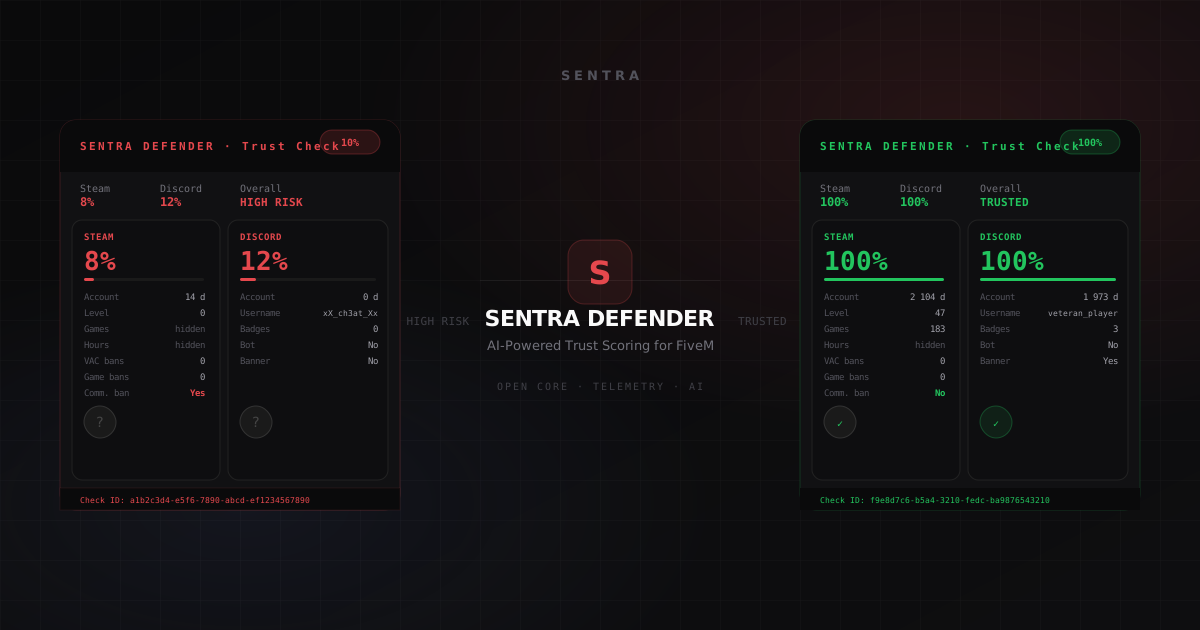
Here's what a Defender report looks like in practice. Every check includes a Steam panel, a Discord panel, and a combined overall score.
Example — High Risk Profile
A 14-day-old Steam account with a community ban, zero level, hidden library, and a brand-new Discord account with an obvious username is exactly the profile that Defender flags. The server operator sees this before the player connects — and can block, monitor, or allow as they see fit.
Example — Trusted Profile
A Steam account over 5 years old with 183 games, level 47, zero bans, paired with a Discord account nearly as old with 3 badges and a custom banner. This is a player with real history across the internet — hard to fake at scale.
The AI Model
The trust score isn't just a weighted average. It runs through a model trained on verified ban data contributed by every Sentra server in the network.
When a server bans a player for cheating through the Sentra dashboard, that event becomes a training signal. Over time, the model learns which combinations of account characteristics correlate with verified cheaters — and weights new checks accordingly.
This means the more servers that participate, the smarter Defender gets. A solo server running Defender gets a good tool. A network of 500 servers running Defender gets a model that has seen nearly every cheat pattern in the FiveM ecosystem.
What the model considers
- Account age velocity — how old are both accounts relative to each other? Cheaters often create new identities simultaneously.
- Library/activity ratio — a Steam account with 200 games but 0 visible hours is statistically unusual.
- Cross-server ban correlation — has this identity, or identities sharing its hardware fingerprint, been banned on other Sentra servers in the past 90 days?
- Session behavioral patterns — from telemetry, how long does this type of profile typically stay before being kicked or leaving on their own?
- Discord signal weight — Discord accounts are significantly harder to farm than Steam accounts. A well-aged Discord with activity history is a strong positive signal.
Open Core and GitHub
Sentra Defender is open core. The core trust check library, the FiveM resource integration, and the Discord bot are all available on GitHub under an open license.
The AI model, the cross-server telemetry network, and the Sentra dashboard integration are part of the Sentra subscription — but you can run standalone Defender checks for free against our public API using your Sentra API key.
This means:
- Any FiveM server can run Defender checks, even without a paid Sentra plan.
- Sentra subscribers get deeper integration: automatic pre-join blocking, dashboard history, AI-enhanced scoring, and alerts directly in the Sentra admin panel.
- The community can audit exactly what the open-core components do with player data.
Discord Bot Integration
Defender ships with a Discord bot that any server can add. Server staff can run /check [steam_id] or /check [discord_id] directly from their moderation channel and get a full trust report back in seconds — formatted exactly like the examples above.
For Sentra subscribers, the bot gains additional capabilities:
- Pre-join alerts — get a DM or channel ping whenever a player below your configured trust threshold attempts to join.
- Ban sync — bans issued from the bot propagate to the Sentra dashboard and feed back into the AI model.
- History lookup — see every previous check run on a given identity, with timestamps and score deltas over time.
Why Not Global Bans?
Global ban lists for FiveM have been explicitly prohibited by Cfx.re policy for years — and for good reason. A single bad actor on a ban list can get a legitimate player blocked from the entire platform. There's no appeals process, no transparency, and no accountability.
Defender takes a different approach: give server operators the information, let them decide. The score is a recommendation, not an enforcement action. You set your own thresholds. You decide what score is too low for your community. You can always override the recommendation.
This is compliant with Cfx.re policy, respects player autonomy, and keeps decision-making where it belongs — with the people who know their community.
Getting Started
Defender is available today. Getting started takes under five minutes:
- Install the FiveM resource from the GitHub repository into your server's
resourcesfolder. - Add your Sentra API key (available in your Sentra dashboard) to the resource configuration.
- Set your threshold — the minimum trust score required to join. We recommend starting at
30and adjusting based on your community. - Add the Discord bot to your staff server for manual lookups and alerts.
If you're already a Sentra subscriber, the dashboard integration is automatic — check the Defender tab in your server panel.
What's Next
Defender is launching today in its first stable release. The roadmap includes:
- Behavioral fingerprinting — linking identities across hardware changes, not just license keys.
- Appeal flow — a structured way for players to dispute a low score with evidence.
- Regional trust networks — opt-in data sharing between servers in the same community or region.
- Webhook support — send trust events to any external system via HTTP.
- Public API v2 — batch lookups, historical score graphs, and trend data.
We'll be sharing progress on each of these in future posts. If you have feedback, questions, or want to contribute to the open-core components, find us on Discord or open an issue on GitHub.
Sentra Defender is available now. Get started →